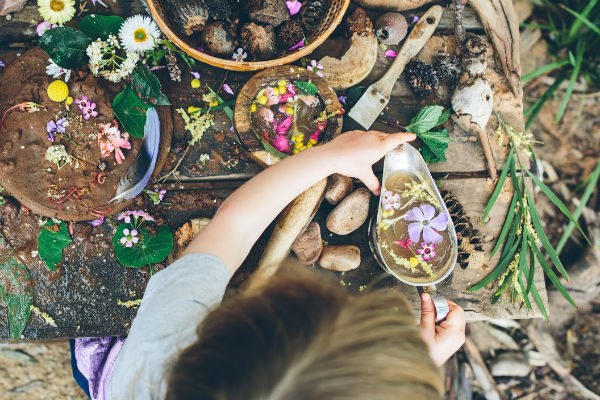
The Nature of Play

What is nature play all about?

Once upon a time, and not all that long ago, children spent their free time climbing trees, exploring the local creek, building forts and cubbies and making all kinds of discoveries with their friends. Days were spent outdoors, unsupervised and unstructured. This is nature play. There were no smartphones, laptops or tablets to entertain. There were no structured play dates or indoor play centres and it was safe to roam around the neighbourhood and play with children in the street. But in just one generation, technology has become the substitute for free play and life for children has moved from outdoors to indoors, from active to sedentary. According to a 2013 Planet Ark study, 1 in 4 children have never even climbed a tree. 1 in 5 children today aged 6-9 years old, spend more than 2 hours/day in front of a TV, increasing as children get older. Children are losing their connection to the natural world. The loss of ‘nature play’, is having a negative impact on children’s physical, emotional and social development, their health and wellbeing, their ability to make decisions, solve problems, assess risks and become resilient young people and adults.

So what can you do?

There is loads you can do to help restore the balance for your children. The first step is to replace children’s screen time with green time. Allowing children the opportunity and permission to spend uninterrupted time outdoors will lay the groundwork for children to learn about themselves, the world around them and how they function in it. Their senses will be fully engaged, curiosity nurtured, problem solving skills put to the test and they will learn about their capabilities and limitations, lifelong skills that will be invaluable.

Nature Play SA is a small not for profit organisation that understands how important it is for children to recapture the time to play and be in nature. It has been established to empower parents, educators and the broader community to help make unstructured time in nature, an everyday part of childhood. Nature Play SA’s website, Facebook and Instagram sites aim to make it easy for families seeking ideas, inspiration and guidance. Their website includes lists and information sheets you can download free. Affordable events families can enjoy throughout the year showcase nature play in action – cubby building, mud play, whittling and weaving, geocaching. The summer program of events will be released soon. A small online shop offers books to inspire and products to support children’s time outdoors. And a newly launched, unique membership program, designed for families, the Nature Play SA Collective, will provide members with ideas, encouragement and guidance on the little things you can do that will make a big difference.
Get your family started with your very own backyard nature play space

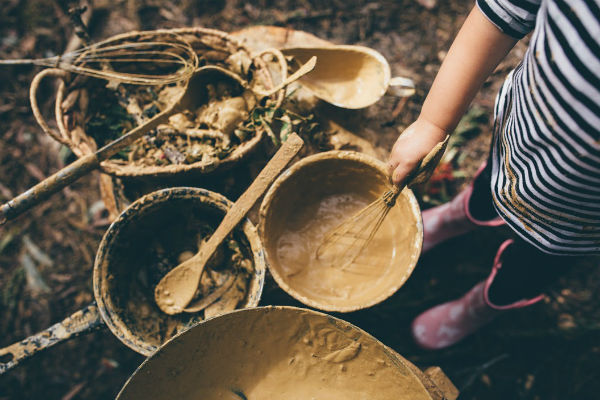
By using a few simple elements from nature, you can create an inspiring backyard for your children where they will be immersed in sensory stimulation that will provide endless creative fun, discovery and creativity.
Excerpt from Natural Playspaces Families available on the Nature Play SA website

Secret Places – children love hiding spaces and building cubbies and forts where they can play by themselves or with their friends.

Water & Sand – a sandpit and water source, the perfect combination for hours of creative fun and play.

Mud – the ultimate sensory experience. Build a mud kitchen, create a mud pit, or make a mud wheelbarrow.

Something to climb – Climbing is instinctive for children and climbing trees, a rite of passage. It develops their fine and gross motor skills, co-ordination and risk-taking exploits.

A Garden to grow – having their own little patch of garden to tend with their own tools, teaches children how to care for things and to understand where food comes from.

Inspiring Creativity – provide a space and props to nurture your budding artist, actor, musician, explorer or engineer.

Something to swing on – and make it long! There is nothing better than the freedom and exhilaration of seeing how high and fast you can go.

Loose parts – unstructured play at its finest – build a collection of pinecones, log rounds, rocks, sticks and seedpods. They have no defined purpose so children can move, sort, cart, roll, build, carry, collect and manipulate how they wish.

Nature play

@natureplaysa

natureplaysa.org.au 

You may also like

Play All Day App creators Emma Meyer, Gemma Rooke and Jacqui Burton sitting outside on a colourful blanket.

Play All Day app helps parents reduce screen time through play

In the age of screens, Aussie mums launch app to bring back the magic of play. “Will you play with me?” Five little words that can spark overwhelm in even the most well-intentioned parents. Between busy schedules, mental load and constant demands, coming up with engaging activities can feel like just another task, often leading screens to become the easy fallback. Three Australian mums and play experts, Emma Meyer, Gemma Rooke and Jacqui Burton, know this struggle well. Together, they created the Play All Day app to help families rediscover simple, meaningful play at home. Gemma, a homeschool mum of two boys, has long used play as a core learning tool. “Before Play All Day, I was doing these activities with my own children and sharing them on social media,” she said. “Parents were eager for ideas to support their children’s development and while social media can be helpful for this, it can also be incredibly distracting and overwhelming. It’s easy to get sidetracked or save a bunch of content that you never return to.” She began developing an app that would remove the guesswork by curating evidence-based activities in one easy-to-use place. Partnering with early childhood educator Emma Meyer and entrepreneur Jacqui Burton, the idea quickly grew into a comprehensive resource for families. Emma’s background in early childhood and primary education helped shape the developmental focus of the activities. “A passion for play was instilled in me during my studies in early childhood education back in my university days,” she said. Observing her own children also inspired many of the ideas now included in the app. “For example, watching my children around the 10-month mark developing their pincer grip and trying to pick tiny bits of fluff up off the floor led to me creating opportunities for them to develop that grip and strength in their fingers, like the ‘cheerio pluck’ activity.” Simple activities for every age and stage The Play All Day app features a library of easy play ideas that can be set up at home using everyday materials. Activities can be searched by age, skill, activity type or even items already available around the house, supporting children from newborn through to the primary school years and beyond. Each activity includes clear instructions along with images or video to demonstrate how to set it up. “With the activities created by mums, they have been able to provide ideas that kids will actually be interested in and include plenty of great tips for making it simple,” Jacqui said. Why play matters more than ever In a world increasingly dominated by screens, experts warn that play-based childhood experiences are declining. Social psychologist Jonathan Haidt has raised concerns about screen time and children’s mental health, describing a shift from play-based childhood to phone-based childhood as a major contributing factor to rising mental health challenges among young people. A report by Common Sense found children aged eight and under spend around two and a half hours a day on screen media. By age four, more than half of all children own their own tablet, and 75 to 80 percent of parents report concerns about screen use. Another long-term study tracking children from infancy into adolescence found high screen exposure before age two was linked to measurable changes in brain development. These changes were later associated with slower decision-making at age eight and higher anxiety symptoms by age 13. “Overall, play gives children the opportunity to explore and make sense of their world in the ways that are most meaningful to them,” Emma said. “I believe play builds strong and self-aware individuals.” Supporting families and professionals alike Since launching in late 2025, the Play All Day app has gained traction internationally, with downloads across more than ten countries. Its audience extends beyond parents, with educators and health professionals also incorporating the activities into their work. Speech pathologist Jules Tushuizen, who has worked in child development for nearly two decades, says the benefits of play-based learning are clear. “The research is very clear — when children learn through play, they learn faster and retain more,” she said. “In our speech and occupational therapy sessions, we often spend time helping parents rediscover just how valuable play really is. It might look like fun, but that’s exactly the point. When children are engaged and enjoying themselves, their brains are learning.” For families feeling the pressure of raising children in a digital world, the app offers a practical way to reconnect, slow down and rediscover the simple joy of play — even if it just means enjoying a hot cup of coffee while the kids are happily engaged. For more information, visit: playalldayapp.com.au Follow KIDDO on Instagram and Facebook, and subscribe to our weekly newsletter

Read More