
Interview by Liv Williams
When a baby is born the room finds a new centre of gravity. The space that once held a woman at its centre begins to orbit the baby instead. Visitors ask about feeding and sleep. Photos are taken. Messages arrive. And somewhere in the blur, the mother’s body begins the slow, complex work of healing.
Amelie Cazzulino, founder and CEO of Bare Mum, wants us to change the language we use for that season.
“What happens to a woman’s body after birth isn’t cosmetic, optional or indulgent — it’s recovery from a complex physiological event,” she says. “Birth is a normal biological process, but that doesn’t make it gentle.”
For Amelie, the distinction between “self-care” and “recovery” is not semantic. It shapes how women see themselves and how the world treats them.
“Calling this ‘self-care’ softens the reality of what’s actually happening and subtly frames a mother’s needs as something extra, rather than essential,” she explains. “When we use the language of recovery, we give women permission to take their healing seriously, physically, emotionally and hormonally.”
The concept of self-care, she says, has been diluted. “Self-care has come to mean small, optional acts of indulgence — a bath, a candle, a moment alone. Those things can be lovely, but they don’t capture the reality of what’s happening in the postpartum body.”
After birth, women may be “bleeding, sore, swollen, stitched, leaking milk, emotionally raw, hormonally shifting and often sleep-deprived.” Framing that as self-care risks minimising the scale of it. “Recovery language is more honest. It recognises that this is a period of physical repair and emotional recalibration, not a lifestyle choice.”
The gap in support became obvious to Amelie long before Bare Mum existed. After being diagnosed with endometrial polyps and a breast hamartoma, she underwent surgeries and faced difficulties conceiving and breastfeeding. What she noticed, again and again, was how quickly the focus moved away from the mother.
“I noticed it in small but telling moments: how quickly conversations pivot to the baby, how little practical guidance exists for what a woman’s body goes through after birth,” she says. “There’s incredible education around pregnancy and birth preparation, but the recovery phase often feels like an afterthought.”
When she began speaking to other women, the pattern held. “So many shared that they felt underprepared for what recovery would actually involve. There was this quiet expectation to ‘get back on your feet’ quickly, even though their bodies were still very much in a healing phase.”
Culturally, we still expect mothers to perform competence and gratitude almost immediately. Amelie believes that pressure runs deep.
“We’re surrounded by images of women who appear to ‘bounce back’, love every moment, and manage it all seamlessly,” she says. “There’s very little visible space for messiness, pain, grief, overwhelm or slowness.”
And beneath that is another message.
“There’s also a deeper narrative that women should be grateful and resilient; that because you have a healthy baby, you should be okay. But two things can be true at once. You can love your baby deeply and still be struggling physically and emotionally.”
So what does recovery actually look like?
“Physically, recovery is slow, uneven and deeply individual,” Amelie says. “Emotionally, it’s often a mix of tenderness, vulnerability, joy, grief, identity shifts and nervous system overload.”
Importantly, it isn’t linear. “Recovery isn’t about ‘bouncing back’, it’s about gently moving forward with support, patience and care.”
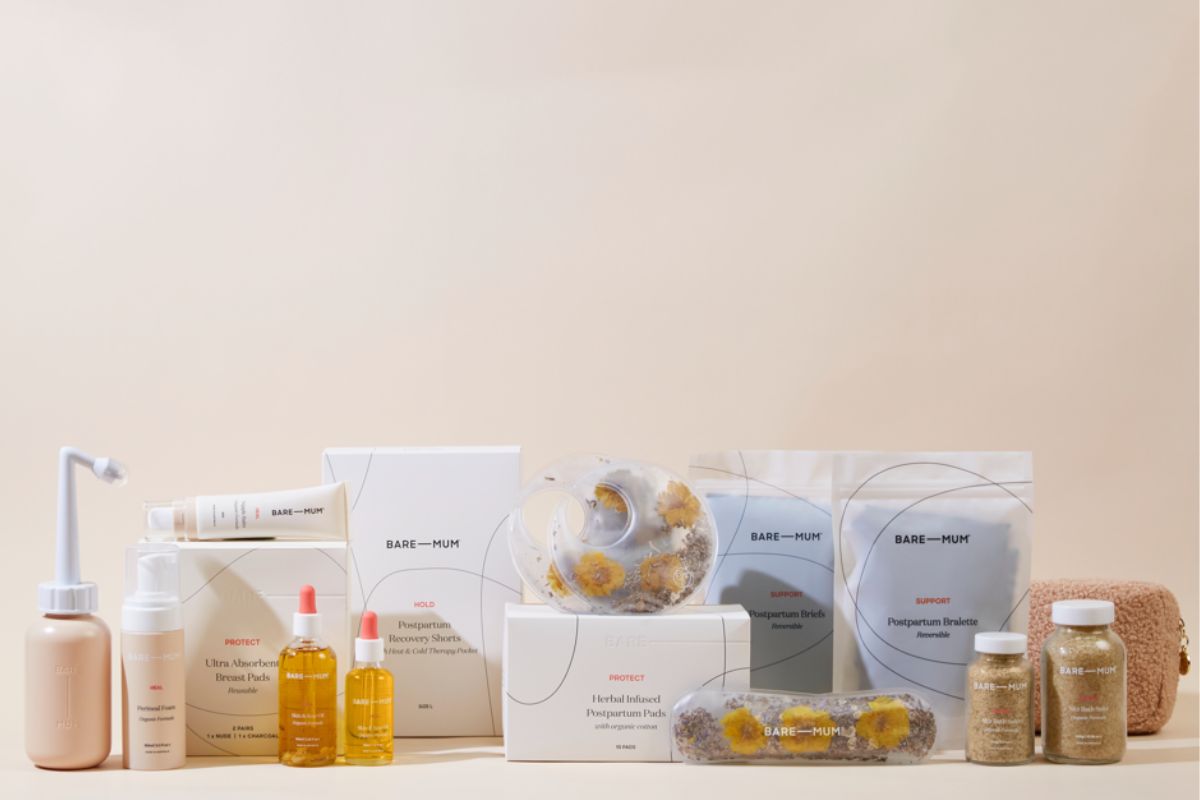
That philosophy sits at the heart of Bare Mum, which pairs evidence-led education with purpose-built postpartum products. For Amelie, those two elements cannot exist in isolation.
“Products alone don’t solve the problem if women don’t understand what’s happening in their bodies or what support is available to them,” she says. “At the same time, information without practical tools can feel abstract. We wanted to bridge that gap.”
Her hope is that better recovery support changes the emotional tone of early motherhood itself.
“I hope it helps women feel less alone, less rushed and less like they’re failing if they’re struggling,” she says. “When recovery is supported properly, women can move through early motherhood with more softness toward themselves.”
Ultimately, she wants a cultural shift.
“I’d love to see postpartum framed as a legitimate recovery period, not a soft, optional add-on to motherhood. A time that deserves structure, support, resources and respect.”
Language shapes expectation. Expectation shapes behaviour. And behaviour shapes experience. If we begin to call postpartum what it is, recovery, we might finally give mothers the permission they have always deserved: to heal.
Find out more: baremum.com.au | @baremum
Follow KIDDO on Instagram and Facebook, and subscribe to our weekly newsletter