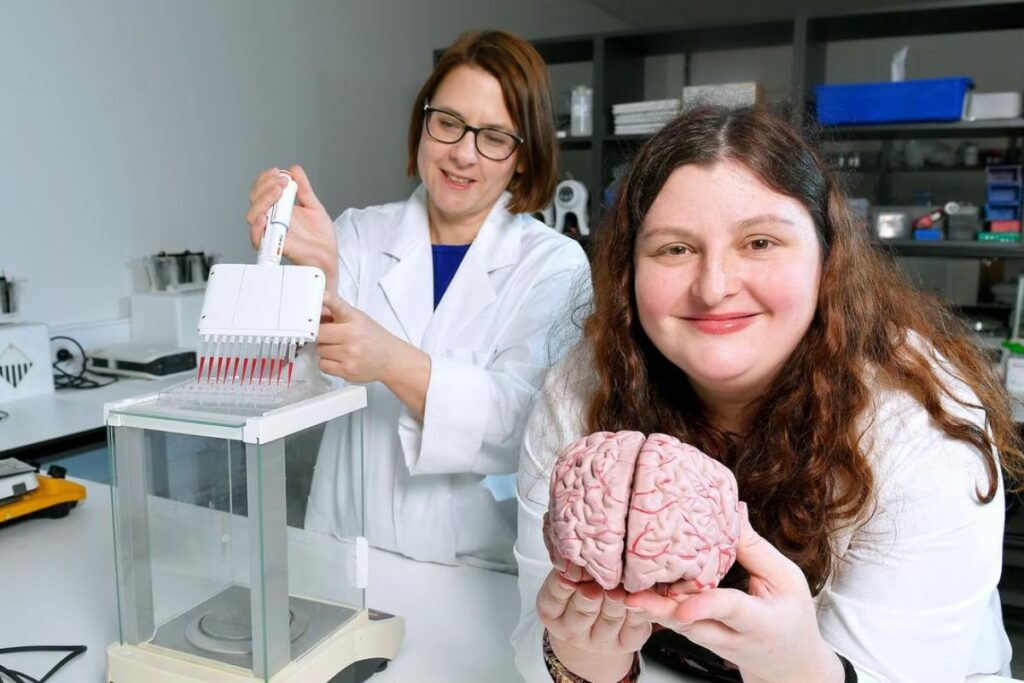

Pregnancy is a full body experience. When pregnant for the first time with her son Alexander, A/Professor Lyndsey Collins-Praino expected the morning sickness and to feel more tired than usual. What she was less prepared for, however, were the surprises such as bleeding gums, a stuffy nose and even bigger feet. Given that pregnancy affects nearly every part of the body, what does this mean for the brain?
Up to 80% of pregnant women report feelings of memory loss and difficulty concentrating. In line with this, a meta-analysis of 20 studies of 709 pregnant women and 521 non-pregnant women by researchers at Deakin University found that pregnant women performed worse than non-pregnant women on objective measures of general cognitive function, executive function and memory, especially during the third trimester. When women were followed over the course of their pregnancy, cognitive function mainly declined between the first and second trimester, before becoming more stable later in pregnancy. Similarly, a 2025 systematic review of 31 studies of 1,596 pregnant women and 1,450 non-pregnant women found slight declines in memory and attention with pregnancy, with the effects lasting, at least to some degree, into the early postpartum period.
Several theories have been put forward to explain these differences, ranging from reductions in sleep quantity and quality to hormonal changes during pregnancy. Interestingly, research suggests that while sleep deprivation during pregnancy can make one feel more forgetful, it doesn’t actually affect performance on objective measures of memory. In contrast, several studies have supported that the dramatic increases in hormones like estrogen, progesterone and cortisol that occur during pregnancy significantly affect brain structure and function, with knock-on effects for cognition.
It’s important to emphasise, however, that not all research is consistent. Multiple studies have found no differences in cognitive performance with pregnancy, and a 2022 study in the journal Memory reported that pregnant women in their third trimester actually showed better learning and retention of parenting-relevant information compared to women who had never previously been pregnant.
Even when declines in cognition during pregnancy are seen, they are usually minor and their impact on day-to-day life is unclear. Further, these cognitive changes largely resolve within the first year or so following birth. Even when women continue to report feelings of memory loss into the postpartum period, most research suggests that this is not associated with actual differences in performance on objective cognitive measures, and instead may be influenced by factors such as sleep deprivation, stress and mood changes.
While the effects of pregnancy on cognition are therefore not entirely clear, what is evident is that pregnancy is a time of great change for the brain itself. The period of matrescence, a term for the process of becoming a mother coined by anthropologist Dana Raphael, is similar to adolescence in its capacity for brain adaptation or neuroplasticity. Landmark studies by Elseline Hoekzema at Leiden University and others have found that pregnancy leads to significant reductions in grey matter volume within brain regions important for social cognition, as well as changes in brain function, particularly within certain neural networks such as the default mode network. Notably, research suggests that these changes may be long-lasting, persisting for at least two years postpartum, with some research suggesting they can still be seen up to six years following birth. Additionally, a recent 2026 study reported similar changes during a second subsequent pregnancy, suggesting that they are not unique to first-time mothers.
Far from being detrimental, these changes are thought to be adaptive, helping prepare one for becoming a parent by fine-tuning neural networks to make them more efficient and specialised. These brain changes are linked to quicker, more sensitive responses to infant needs, better mother-infant bonding and even an enhanced ability to detect threats. Interestingly, these brain changes may also be beneficial long-term, with emerging studies suggesting benefits for cognitive function in middle and older adulthood. This may be because the parental brain needs to adapt to complex and challenging demands, making it more resilient and better able to cope with age-related decline. These cognitive effects do not appear to be equal across all mothers, with greater benefit seen in those with either two or three children, or who were older at the time of pregnancy, perhaps due to socioeconomic factors. Such benefits also do not appear to be unique to mothers, with similar positive effects observed in fathers.
Given our growing awareness of the potential benefits of pregnancy and parenthood more generally for lifetime cognitive health, it might be time for the concept of “pregnancy brain” to find itself a better PR agent.
By A/Professor Lyndsey Collins-Praino, Head, Cognition, Ageing and Neurodegenerative Disease Laboratory, Adelaide University
Follow KIDDO on Instagram and Facebook, and subscribe to our weekly newsletter