If you’ve ever stared at a real estate listing mentioning “zoned for [insert popular school]” and wondered what that actually means for your family, you’re not alone. School zoning in South Australia trips up even parents who’ve been through it before, mostly because the system works differently depending on where you live and what type of school you’re looking at.
Here’s how it all works, without the jargon.
What is a school zone?
A school zone is a defined geographic boundary around a government school. If you live inside it, your child has priority enrolment at that school. Most metropolitan high schools in Adelaide are zoned, along with a good number of primary schools, but not all of them.
Zoned vs unzoned schools
This is the bit that catches people out. Not every government school has a formal zone. If your local school doesn’t, you fall into a catchment area instead, which is simply the geographic area closest by road to that school compared with other nearby unzoned schools.
In practice, a zoned school guarantees priority to everyone inside its boundary. An unzoned school’s catchment is really just “which school is closest to you,” worked out by road distance rather than as the crow flies.
How to find your zoned school
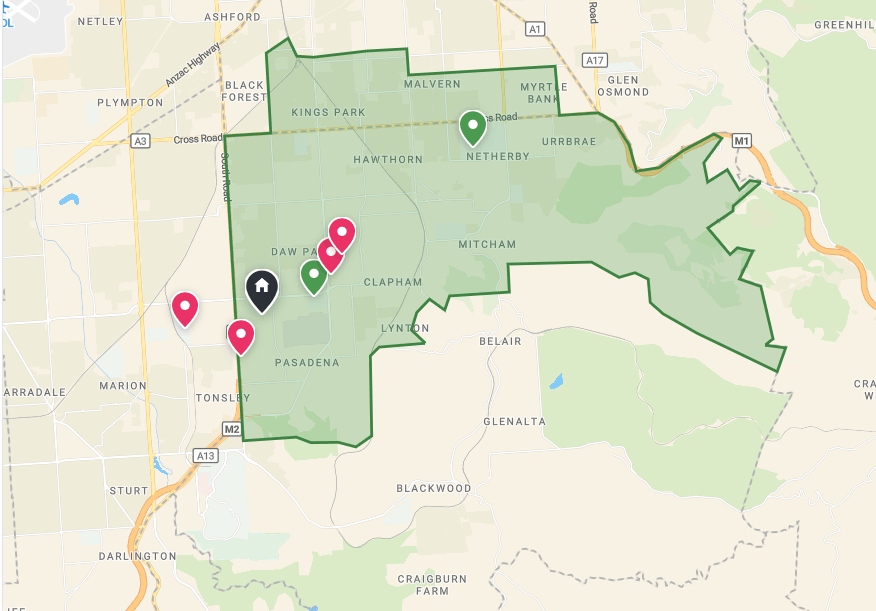
The Department for Education runs a find a school zone or catchment area tool where you plug in your address and it tells you exactly which zone you’re in, complete with a map. If your address isn’t inside a zone, the tool will show you your nearest unzoned school by road.
This is worth doing before you fall in love with a rental or put down an offer on a house. “Close to a good school” and “zoned for a good school” are not always the same postcode.
Living in outer metro Adelaide or regional SA
If your home is more than 5km from your nearest school, you may be eligible for the school bus service or a transport allowance under the department’s school transport policy, rather than being expected to make the trip yourself twice a day.

What are shared zones?
Some schools share a zone or overlapping area, which means families living there can nominate a preferred school among the options. It’s not a free-for-all though. If demand outstrips places, allocation is weighed up using factors like:
- Available spaces at each school
- Whether a sibling already attends
- Distance from home
- Particular curriculum needs
- Social and family links
- Transport needs
What happens when your zoned school is full
Popular zoned schools can hit capacity, and some operate under what’s called a capacity management plan. If a school with one of these plans can’t offer a place to a family who is genuinely zoned for it, the school itself steps in to help that family enrol somewhere nearby instead.
Being zoned for a school is a strong entitlement, but it isn’t an unconditional guarantee if the school has genuinely run out of room.
Can you apply for a school outside your zone?
Yes. Families can apply to any government school, zoned or not, whether or not it’s their local one. Whether that application succeeds comes down to whether the school has spare capacity once local, zoned students are accounted for.
If a non-local school does have room, your application gets considered based on distance from home to the school, curriculum needs, social or family links, and transport needs. Automatic entry applies in specific circumstances, such as an older sibling already attending the school, selection into an approved special interest program, or a principal’s discretion in special circumstances.
It’s worth contacting the school directly to ask about their current position before you get attached to the idea.
What about private and Catholic schools?
Zoning is a government-school system. Independent and Catholic schools set their own enrolment policies, which typically favour siblings, particular faith communities, or families already connected to the school rather than geographic zones. If you’re weighing up a government school against a private or Catholic option, zoning simply won’t be part of the equation on the non-government side.
Practical tips for families
- Check the zone before you sign a lease or make an offer, not after. Real estate listings can be optimistic about which school a property is “close to.”
- If you’re borderline on a boundary, call the school directly. Boundaries can look different in practice than they do on a map, especially along main roads or newer housing developments.
- Ask about sibling policies early if you have a younger child coming through. Many schools give priority to siblings of current students, which can matter more than strict zoning in a full school.
- Keep a copy of your zone result. If you end up needing to apply out of zone somewhere else, you’ll want to show you’ve done your homework on the local option first.
Zoning isn’t designed to make life difficult. It exists so that every family has a guaranteed local option. But knowing exactly where you sit before school tours and applications start can save a lot of last-minute stress.
Follow KIDDO on Instagram and Facebook, and subscribe to our weekly newsletter